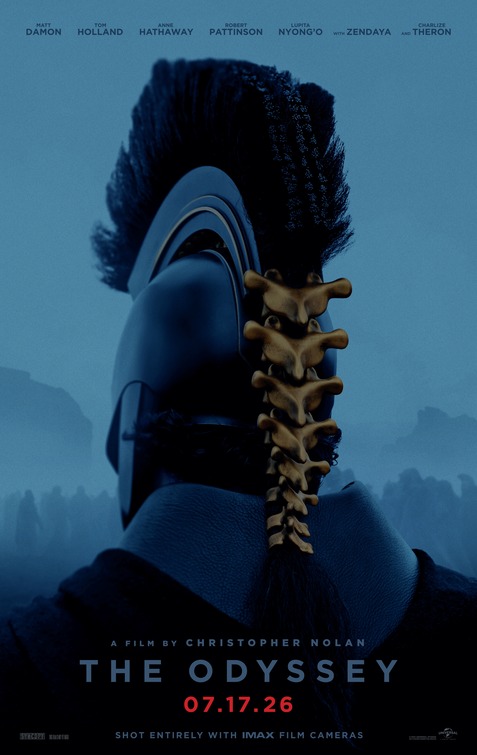
I speak the visual language. My love of words is my attempt to commit what I see and feel to memory and history. I adore people who speak the language in their everyday lives, Eni Popoola and Tenicka Boyd, and in their work, namely Ruth E. Carter. An apparel designer by education, I believe strongly in the power of communication via clothing and adornment. I was pleasantly surprised to be taken by a costume in Christopher Nolan’s interpretation of The Odyssey (2026). The epic’s costume designer, Ellen Mirojnick, loves storytelling and believes that communication is one of the most important skills we can cultivate. In film and television, costumes communicate a character’s status, background, and even ethic without dialogue. Agamemnon’s armor accomplishes this in exquisite fashion.
It is apparently a controversial costume. Drawing comparisons to Batman, more on that later. Personally, I missed the complaints and I’m glad. Experiencing art without anyone’s baggage is a small blessing in the age of constant contact with the thoughts of thousands on the world wide web. I’ll chalk the noise up to the costume being an example of robust storytelling.
Odysseus tells Calypso, “I don’t know, I feel.” I haven’t read Homer since high school so I couldn’t recall Agamemnon’s lore but as soon as he appeared on screen, I felt who he was. An impressive and imposing figure, allegiance won through respect, fear, or both. Through achievement, survival, and the people he’s helped to crush or subdue. It fits a man who goes to war to break trade route control, who could reconcile with sacrificing his child for fair winds or threaten the child of another king.

Ellen Mirojnick and her team must know this is a gorgeous costume. The beauty is in the richness of the black across the planes, angles, and curves. The bronzed vertebrae at the back of the helmet, a cast or gilded after removal? This man must have fought his battles and proved his strength and power in tangible ways we don’t want to encounter.
A contrast to men in power today, who obtain all the trappings of status without talent or skill to earn said status. They desire to be heralded and yet are not good at anything. Not a physical or psychological architect, orator, writer, visionary, athlete or scientist among them. They seek attention for attention’s sake, hoping to matter and receive praise because they’re well-known for being known. That may sound impressive to someone, but it lacks substance. Equivalent to yelling in the middle of a library, a spectacle disturbing everyone else. It’s rather desperate.
Agamemnon is not a pious figure, simply an impressive one. Beguiling in his adornment. He is skilled, as noted in The Iliad: wins a javelin contest on known proficiency in Book Twenty-Three, a preferred Greek warrior opponent for Hector in Book Seven and slices his way through a “day of glory” in Book Eleven. He has proven himself formidable in battle. Agamemnon earned his status through brutal action, fitting in Greek legends.

For some viewers Agamemnon appears to “not get his hands dirty” as he walks through the battle of Troy. He’s well dressed, easy to spot, while his men execute everyone they come across. It feels too close to our real world. We have a host of people who’ve earned nothing and stolen everything. Reprehensible and disrespectful because they’ve never sacrificed or fought for anything. There is no resume, just propping themselves up with the money, ideas, and time they’ve stolen. They will hide when wars are waged. Antinous is more our speed. A spoiled, entitled, rude, backstabbing, sniveling coward. He has never seen a true battle.
In real life, cowards use status to hide their shortcomings and insecurities. This would not work in Agamemnon’s world. The armor says he is ruthless. He stole his daughter, Iphigenia’s, life for fair winds from Artemis, planting “poison” the heart of his wife, Clytemnestra. But he is not useless or weak. Agamemnon’s armor is ominous and elusive. Just visible in the open Trojan gate, no shields or soldiers in front of him, effectively a black hole. A gravitational pull so strong nothing can escape it. First Clytemnestra, second the Greek forces raised to retrieve Helen and finally the Trojans, stuck in their home as soldiers flood in to do their absolute worst.
The armor only works in black. Any other color would have been too loud and in this world, Agamemnon chooses his words, and in his mind his actions, carefully. Black is calm, quiet as the night sky. Some nights illuminated by the moon and stars, other nights a curtain of mystery. His armor is regal and serious, foreboding, carrying his familial curse. Nothing will end well here despite the magnificent beauty. I think the beauty is what disconcerted detractors viewing the film poster. They can’t reconcile beauty and power.

People undermine what they don’t understand. Circling back to the Batman comparisons. Does all black attire, a slightly obscured face in a helmet, and a cape get to you? Or is it the Classical Greek inspiration versus the Late Bronze Age accuracy? The Odyssey is a 3000-year-old work of fiction, which means the creative teams have license to tell the visual story as they see fit to meet the director’s intention. The black plumage, molded breast plate, and gilded clasps and spine are purposeful visual communication.
The attempted jab is lazy and uninspired. All black plus mask plus cape equals Batman. Black Panther has a similar look in Christopher Priest’s comic run drawn by Mark Texeira. Agamemnon is not a brooding hero or an ethical king; he is a king’s lesson. A more apt comparison is Darth Vader. Ominous, commanding, arresting. The windows to the soul, the eyes, hidden. Quiet, highly skilled, and from another cursed family with violence passed through generations. A terrible person who earned their reputation. The choices in Agamemnon’s armor reflect creativity, ingenuity, whimsy, and wonder to tell this king’s story.
His authority wasn’t purchased, it was earned. Agamemnon’s downfall is hubris. In Hades he advises Odysseus to not make his same mistake, return home quietly with no fanfare and observe. “Don’t walk in the front door expecting garlands and praise.” I would like to know which was more painful for him, sacrificing his daughter or Clytemnestra catching him off guard with a dagger thrust to his throat, knowing he caused her bitterness and sealed his own fate. I appreciate Benny Safdie not just wearing but embodying the costume. It could easily swallow a person, but he projected the character from it, adding credibility to gravitas.
I’m proudly sensitive about art and artists. Department heads make decisions with purpose in films and all creative work. There is a reason for almost everything, with the occasional stroke of inspiration that must be met on the fly. The armor is the former. Despite this, the Venn diagram of people who like to complain and people who like to share their misery meet in Agamemnon’s walk-in war closet.
I’m more interested in seeing when the modern-day Antinous’ meet their shame. Agamemnon and Antinous end up in the same place. One lulled into a false sense of security of his own making and the other aware while denying accountability for his shame as he’s sent to Hades. Both showcasing reprehensible actions but at least one stood in battle throughout his life. Put in effort to achieve his status. Unfortunate that he did not atone or apologize for the suffering he caused. Maybe it would have granted him a few more years.
